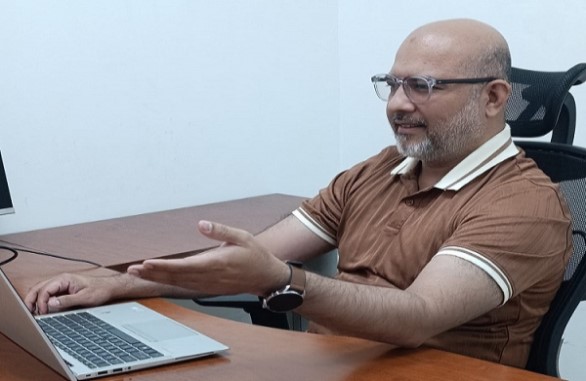
Syed Kashif Zaidi, is a global digital transformation leader with 22+ years of experience in SAP consulting, enterprise architecture, and senior project management. His career journey started as computer operator at K-Electric and goes to Deputy General Manager of SAP. Now he leads international projects as Senior Project Manager at Tally Marks Consulting in Riyadh. Kashif is a certified SAP Project Manager (Activate for Cloud), PMP, Lean Six Sigma Green Belt, and TOGAF 9.2 specialist who delivers landmark SAP “firsts” and bridges boardroom strategy with ground-floor realities. Recently in a Podcast interview he shared his experience with SAP.
Question: During your career, the industry shifted from the traditional SAP ASAP methodology to the agile SAP Activate framework. From an execution standpoint, how has the practical definition of "successful delivery" evolved over your 22 years in the field?
"Over my 22 years, the meaning of successful delivery has shifted dramatically. In the old ASAP days, success was rigid: blueprint, build, test, and hit a fixed Go‑Live date within budget. It treated projects like concrete buildings — once finished, they were done.
Today, with SAP Activate and Agile, we see delivery as a living baseline. Go‑Live is no longer the end; it’s the end of the beginning. Success means establishing a stable foundation that can evolve, improve, and scale continuously.
Activate’s Build to Engage philosophy, Fit‑to‑Standard workshops, and iterative sprints redefine success by:
De‑risking through continuous validation — users see and shape the system early.
Accelerating time‑to‑value — minimum viable configurations deliver benefits faster.
Structuring the growth runway — the Run phase actively adapts and improves.
I’ve lived this shift firsthand, from migrating K‑Electric’s mindset to Activate, to delivering accelerated phases at Integration Xperts and complex cloud transformations at Tally Marks Consulting. In Riyadh, for example, we delivered two major phases within my probation by focusing on a rock‑solid baseline and letting maturity scale naturally.
Keynote: “In the old days of ASAP, Go‑Live was the end of the story. Today, with Activate and Agile, Go‑Live is just the end of the beginning.”

Question: As a SAP Certified Project Manager, while migrating fast-paced businesses to cloud environments? what advantages do you see of this methodology ?
As an SAP Certified Project Manager specializing in SAP Activate for Cloud, the greatest tactical advantage lies in its strict alignment with the Clean Core philosophy. In legacy ERP systems, excessive customizations created technical nightmares—upgrades became slow, costly, and risky. SAP Activate changes this by starting with Fit-to-Standard workshops and proven global processes, preventing over-customization and ensuring agility, scalability, and seamless cloud upgrades.
Managing this shift requires strong governance and domain expertise. Clients often arrive with a long “wish list” of legacy habits they want to replicate. My role is not to blindly commit but to use SAP Activate’s Explore phase to challenge those practices. I show how standard cloud processes already solve their needs more efficiently. This keeps projects within scope, protects budgets, and accelerates deployment timelines.
Of course, staying close to standard doesn’t mean losing competitive edge. Here, SAP Business Technology Platform (BTP) becomes the tactical weapon. With BTP, we build side-by-side extensions, automated workflows, and complex integrations—isolated from the ERP core. For example, we can protect confidential processes with custom apps or integrate seamlessly with weighbridges, shop-floor systems, or tax authorities. This delivers the best of both worlds: a pristine, stable ERP core and an agile innovation layer that preserves a company’s unique DNA.
Keynote: Cloud migration isn’t about lifting and shifting old processes—it’s an opportunity to clean your core. By combining SAP Activate with BTP, businesses gain the speed of global standards while preserving their competitive edge.”
Question:You managed the integration of Oracle Material Demand Planning Cloud with legacy SAP ECC systems. What is your strategic blueprint for maintaining smooth delivery when bridging entirely different software ecosystems?
Bridging Oracle Cloud with legacy SAP ECC sounds like an IT nightmare, but with the right blueprint it becomes manageable. The complexity lies in architecture: making a modern, cloud‑native Oracle platform talk to a heavily customized, on‑premise SAP system. My strategy rested on two pillars. First, we built custom, secure APIs inside ECC to act as translators, exposing material and inventory data while ingesting Oracle’s demand forecasts. Second, we enforced strict adherence to global standards like REST/SOAP and JSON/XML, eliminating proprietary friction and ensuring seamless data exchange.
The real secret was keeping both SAP and Oracle teams focused on the data contract rather than debating which system was superior. By treating the integration point as a binding agreement and aligning everyone to the common business objective, we turned a high‑risk challenge into a one‑of‑its‑kind operational victory.
Keynote: “Integrating Oracle Cloud with SAP ECC becomes simple when you modernize the legacy core with custom APIs and enforce global standards — turning friction into seamless flow.”
Question. You transitioned Atlas Battery from heavy paperwork to a fully digital environment with SAP Ariba Guided Sourcing. What role does structured Organizational Change Management (OCM) play in preventing user resistance from undermining a project?
The hardest part of digital transformation isn’t configuring software — “the hardest part is changing human behavior.” At Atlas Battery, decades of paper‑based procurement meant resistance was inevitable. Structured OCM became the lifeblood of delivery: sponsors were shown clear ROI, building top‑down confidence, while end‑users were engaged early through interactive change events. Demonstrating how Ariba eliminated tedious tasks shifted mindsets from fear to ownership. This approach didn’t just deploy a tool; it modernized culture and enabled a safe transition to a paperless, agile procurement powerhouse.
Keynote: “Digital transformation fails when people are treated like software. Structured OCM shows leaders the value and proves to users that best practices make daily work easier — turning skeptics into champions.”
Question: Alongside your project management credentials, you hold certifications in Lean Six Sigma (Green Belt), TOGAF 9.2, and ITIL. How do you synthesize these distinct disciplines into a unified approach for enterprise‑scale digital transformations?
Large‑scale enterprise transformations cannot be managed with tunnel vision. ERP projects touch entire ecosystems, so success requires a multi‑dimensional toolkit. My certifications in Lean Six Sigma, TOGAF, and ITIL are not badges — they are structural pillars that de‑risk and accelerate delivery.
TOGAF provides enterprise architecture and impact analysis, ensuring we understand how changes ripple across systems before a single line of code is written. Lean Six Sigma eliminates waste and optimizes processes so we don’t digitize inefficiency. ITIL embeds sustainable service management, making sure support, incident handling, and change control are mature from day one.
Combined with SAP Activate, this synthesis creates a competitive advantage: fixing processes, protecting architecture, and guaranteeing long‑term stability. It’s how I’ve confidently governed portfolios of 40+ SAP resources, integrated Oracle Cloud with legacy SAP, and guided international partners. It allows me to see the whole chessboard and deliver transformations that are architecturally sound, operationally lean, and fully maintainable.
Keynote: “Enterprise digital transformation is a multi‑layered puzzle. By synthesizing TOGAF, Lean Six Sigma, and ITIL, you upgrade architecture, processes, and service culture — not just deploy software.”
Question: When you joined Tally Marks Consulting in Riyadh, you completed two major phases of the MIDCHEM‑SACHLO ERP implementation within your probation period. In such a high‑stakes international project with a new team, what immediate actions did you take to keep it on track and on time?
"Stepping into a high‑stakes project in a new country with a brand‑new team is the ultimate test. My first immediate action is a rapid assessment of three vectors: scope, technology, and talent. I map the deliverables, align SAP Public Cloud capabilities with the client’s chemical processes, and evaluate each consultant’s strengths to match the right person to the right challenge from day one.
Next, I establish strict governance and a clear communication architecture. In multi‑stakeholder international projects, confusion is the biggest driver of delays. By defining roles, escalation paths, and aligning steering committees with deployment teams, we remove ambiguity and keep everyone focused on business objectives.
Finally, my secret weapon is the Daily Scrum. Every morning we ask: What did we achieve yesterday? What are we delivering today? What roadblocks stand in our way? This cadence becomes the project’s heartbeat, ensuring accountability, momentum, and early resolution of issues.
Keynote: “When you inherit a high‑stakes project in a new market, you can’t afford to be reactive. By combining rapid scope assessment with strict governance and daily scrums, you create a culture of momentum where timelines are respected and delays are systematically eliminated.”
Question:To close our discussion, what is the single most critical, non‑negotiable element a project manager must secure to guarantee successful delivery?
After 22 years, the single most critical principle I’ve learned is a relentless focus on business outcomes over project outputs. In the old mindset, success meant delivering on time, within scope, and under budget. But experience has shown that you can meet all three and still fail if processes don’t improve, users abandon the system, or the company doesn’t realize a return on its investment. True success comes from shifting the mindset away from simply delivering a project toward ensuring the organization earns its real value.
To guarantee success, every ounce of effort must align with core business objectives. Teams can easily get lost in technical details or minor fires, so my rule is to constantly ask: “How does this task help us achieve our final goal?” If it doesn’t, we pivot. The business case must remain a living document guiding every scrum, sprint, and steering committee.
My final advice to fellow professionals is simple: don’t just be an administrator of timelines, be a champion of value. Look past the Go‑Live date and focus on building a stable baseline that allows the organization to continuously mature and improve. When you secure commitment to tangible business outcomes, project success becomes a guarantee.
Keynote: “A great project manager doesn’t just deliver on time; they earn the project’s true value. Stop measuring success by the finish line, and start measuring it by the long‑term outcomes you leave behind.”